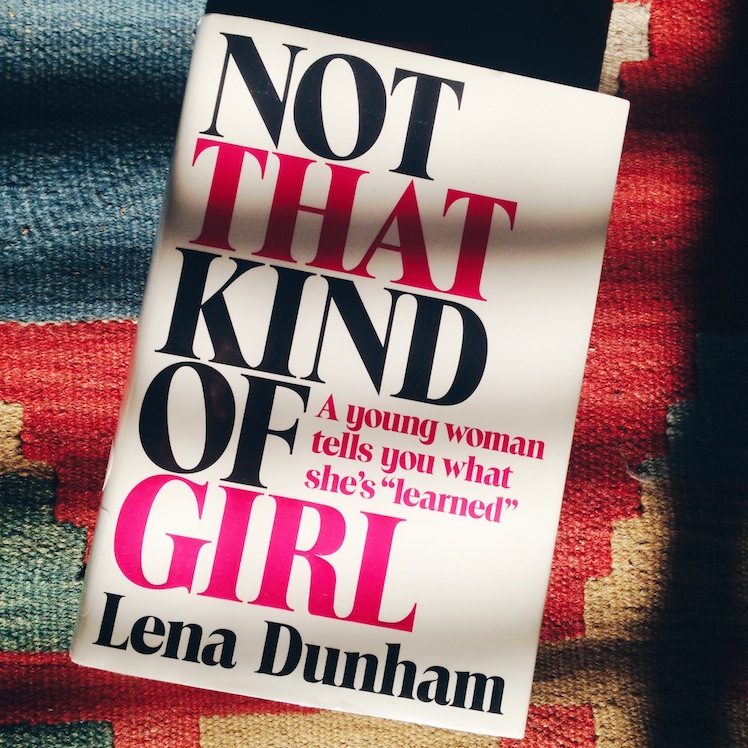
I read Lena Dunham’s memoir Not That Kind of Girl last week and thought it was an enjoyable, quick read—but ultimately not how I wanted to kick off a new year of books.
It clearly compelled me enough to keep turning the pages—I finished it in just a few days. But I felt neither better nor worse off for having read it. I can point to a few reasons why.
I came across Dunham’s award-winning series Girls like I do with most popular shows: late. In catch-up mode, I watched a few episodes back-to-back but couldn’t get into it. Given the show’s popularity, I felt like I was just missing something, until I started seeing criticism of the show piling up. As for the critics’ accusations (it’s racist, vapid) I couldn’t rightfully agree or disagree having only watched a few episodes, but the flak Dunham received for being naked on-screen all the time seemed rife with sexism and double-standards.
Beyond the talk surrounding Girls, I didn’t know much about Lena Dunham until her book came out. By then, I’d read several articles about her, including an interview by Roxane Gay that intrigued me. Clearly she was smart, well-spoken and a feminist. Even if I don’t “get” her work, she seemed like someone whose sensibilities I could get behind.
Not That Kind of Girl was entertaining. It was honest, open, introspective, controversial and funny at times, and I went into it with an open mind, or so I thought, until I found myself criticizing certain passages. And then I’d catch myself: Wait, am I being critical because I really think that, or because I’ve read so much criticism of Lena Dunham?
Dunham said in her interview with Roxane Gay that she wished she would be seen for her craft and not just for her personal attributes. Not That Kind of Girl, of course, puts her personal attributes directly under the microscope (it is a memoir, after all), but it’s still possible and right to be objective about the craft. And I think technically, she does a good job. It wasn’t the stand-up routine in book form she feared she’d be forced into, though it was formulaic. I think it’s probably hard not to be, though, when you set out to write your personal story in which Manhattan serves as the primary backdrop. Still, lines like this Carrie Bradshaw voiceover-esque line stood out to me: “I didn’t know the word for it, but I was happy.” (The word she’s looking for is happy.)
The main criticism of Not That Kind of Girl I’ve seen is that Dunham doesn’t come across as very relatable, and I felt this as well. We shouldn’t be so quick to criticize Dunham for her upper middle-class upbringing without considering how many of our beloved artists came from similar backgrounds. There have been plenty of other rich—and richer—authors before Dunham, and there will be more after her. But the question is: Will her work still be held up next to theirs decades from now? Girls, I don’t know—maybe. Not That Kind of Girl—I doubt it.
I had a hard time writing this review because I don’t feel very comfortable with being a critic. Maybe I was disappointed because I read this and thought I could write something just as good knowing it would never be a bestseller. Maybe that disappointment morphed into irritation because I haven’t.
In any case, here’s an excerpt from a chapter in the “Work” section that I did really enjoy:
“I’ll recount all the interactions where I went from having an engaging conversation on craft with a man to hearing about his sexual dissatisfaction with his wife, who used to be passionate and is currently on fertility drugs. Suddenly, we’re talking about the way his college girlfriend left her boots on when she fucked and how marriage is ‘a lot of hard work.’
What this translates to is: my wife doesn’t turn me on and you aren’t a model but you sure are young and probably some bold new sexual moves have emerged since the last time I was single in 1992 so let’s try it and then you can go back to being married to your work and I’ll go back to being married to an ‘eco-friendly interior decorator’ and I’ll never watch any of your films again.
I’ll talk about how I never fucked any of them. I fucked guys who lived in vans, guys who shared illegal lofts with their ex-girlfriends who were away at Coachella, guys who were into indigenous plant live, and guys who watched PBS.
But I never fucked them.
I’ll talk about the way these relationships fell apart as soon as they realized I wasn’t going to be anyone’s protegee, pet, private fan club, or eager plus-one.”