Judging your worth by productivity

American culture is obsessed with productivity.

You can look to apps (another obsession of ours) for proof. There are all kinds of apps dedicated to tracking, managing, organizing, rewarding and inspiring productivity. You can make lists, set reminders, coordinate your schedules, color-code emails, schedule tweets and more—all in the name of productivity. Ironically, you could waste a lot of hours trying to decide which out of the thousands of productivity apps are worth your time.

As for us writers, when we talk about productivity, we’re talking about progress in the form of putting words on the page. Simple and gut-wrenching as that.

The problem is, our sense of self-worth is often closely linked to our productivity (or lack thereof). If we fall short of even the most arbitrary of goals, it can be devastating not only to our mental health, but to our work as well. Thus creating a cycle of suckiness, or the “I Suck Spiral,” as my boyfriend calls it.

I noticed a somewhat disturbing trend when updating my five-year diary every night. I’ve completed almost three full years of it, and looking back on the past couple of years, so many of the entries refer to how productive I was or wasn’t on any given day. The more productive days reflect happy moods with exclamation points. But on some of the days I deemed unproductive, I go as far as spelling out a few sighs. So dramatic, right? I can practically see the roller coaster of emotions in my jittery handwriting.

Here’s the thing: It’s so much easier to get down on ourselves for not writing enough than it is to write one book, one blog post, one sentence that feels right. It’s hard, and it’s supposed to be, but if we stopped attaching our self-worth to how much we haven’t written and instead celebrated every crappy sentence or shitty first draft we did write, we’d all be better off.

The label “writer” is a part of our identity. Word counts and rejections and bad days are not.

Now, I’m documenting only the little victories and things I’m grateful for in my five-year diary, even—and especially—on bad days. And I don’t need an app to be productive. All any writer needs is someplace to put the words and the faith that those words will come.


Advice from past NaNoWriMo participants on writing your novel


It’s day two of National Novel Writing Month, which means all around the world, writers are furiously typing away at their computers (or staring at blank screens—hey, it’s all part of the process!). I’m happy to report that, despite some major doubts about my plot in the days leading up to NaNoWriMo, I kicked it off by writing more than 2,000 words on day one. Even though it’s Monday and there are a million other things to do, I’m anxious to dive into day two.

But first, I thought I’d share some advice from former NaNoWriMo participants on how to tackle this month like a champ. Even if you’re not joining in on the festivities this month but are thinking about writing a novel, these are great tips to keep in mind.


A reminder that comparison is the thief of joy…

…and that this is supposed to be fun.

Some perspective that the first draft is just a draft…

…and every little bit counts.

Always have a plan for your next session…

…and don’t forget your priorities.

And some words of wisdom from the NaNoWriMo coaches themselves:

Happy novel writing!

Related: 7 tips for making sure you kick butt at NaNoWriMo

11 ways to hone your writing craft

11 ways to hone your writing craft | Witty Title Here

No matter how long you’ve been writing, or how good you are at it, there’s always room for growth.

I find that comforting, as I do the idea that no matter how bursting with love your heart may be, there’s always room for more. (D’aww.) With that in mind, here are 11 ways to continue honing your craft as a writer, whether you’re just starting out or have been going at it for years.

1. Read widely

In his book On Writing, Stephen King wrote, “If you don’t have time to read, you don’t have the time (or the tools) to write. Simple as that.” Better keep a steadily rotating stack of books on your bedside table, then. While you’re at it, get a library card. Read a lot in your preferred genre, and read books by authors who don’t look like you. Read books with challenging prose. Read books with short, snappy chapters. You’ll be inspired in ways you can’t predict, and your writing will be better for it.

2. Reread

Wait, what? Yup. Turns out you unlock the secrets of great writing when you treat that page-turning drama like the textbook from which your teacher lifted all the test questions verbatim. Read once for enjoyment, then read a second time to study the tricks the author has used to switch perspective, go back in time or drop a major plot twist. A great writer will do these things without you even noticing what’s happening. Go back in search of those pivotal moments or scenes, read slowly and pinpoint the exact sentence or sections that did the work and dissect them word for word. Those discoveries will manifest themselves in your own work, especially when you make this a regular practice.

“Those discoveries will manifest themselves in your own work.”

3. Expand your vocabulary

If you read constantly, this will come easily. Don’t just fly over words you’re unfamiliar with. Study them. Context is helpful up to a point, but be sure to look up the words you don’t know or jot them down so you can do it later. (Then write down the definitions so you don’t forget.) You can also check out sites like Otherwordly for a daily dose of unusual words. Won’t it be wonderful to use serein in a sentence? When you learn a new word, you start to see it everywhere, and that’s when its meaning finally soaks in.

4. Seek feedback

When you’ve tweaked and blinked at a piece for too long, it can be near impossible to know if you’re hitting your mark. If you’ve hit that point, it’s best to hand your story or article over to someone who can look at it with fresh eyes. Find a trusted teacher, mentor or friend who will read your work closely and give helpful, honest feedback. Seek out people who read a lot and will say more than just “it’s good!” If you’re looking for feedback on one thing in particular, say so, but be open to suggestion elsewhere, too.

5. Know your weaknesses

What part of the writing process do you dread, or where do you most often get stuck? Instead of avoiding the problem (or getting exasperated every time you write), identify what gives you the most trouble in your writing. If it’s spelling or grammar, seek out a tutor, have a friend proofread your work or read up on Grammar Girl’s quick and dirty tips. If making sense of a rambling, disorganized first draft gives you problems every time you write, spend the extra time mind-mapping and outlining before you get to work. If you fall prey to procrastination or give up too easily, come up with a plan to help you combat those urges. Whether it’s a regimented routine or rewards system, don’t let yourself fall victim to the thoughts and temptations that crop up in moments of weakness.

6. Challenge yourself

Write outside your genre. Set intimidating goals. Tackle the classic novel you never read in high school. Enter a writing contest. Participate in NaNoWriMo. If we only wrote when the conditions and timing were perfect, we’d never write. No excuses.

“Write the truest thing you know in the least amount of words.”

7. Emulate your heroes

One of the best things about writing is that you’re allowed to experiment as much as you want, and that includes letting your work be influenced by the styles of writers you admire. If Joan Didion is your literary crush, spend a couple thousand words on a piercing review of your own psyche. If you love Charles Bukowski’s bare-bones truth bombs, write the truest thing you know in the least amount of words. And if you believe you were Jane Austen in a former life, ask yourself, “What would Jane do?” when writing the final scene in your romance novel. Let yourself be inspired by greatness and see what comes of it.

8. Develop your own voice

There are always a few books in your to-read pile, you’ve studied the greats and you’ve learned all the “rules.” Now forget everything you know and write something only you can, in your voice. That requires not only writing constantly, but cutting out the bullshit or anything that rings false. Your voice is influenced by your gender, age, race, religion, sexual orientation, beliefs, family, upbringing, where you’re from, who you grew up with, the stories you’ve been told and so on. It’s already in you. Voice is a tricky thing to master because it’s so deceptively simple, but you’ll know it when you’ve written something that feels utterly true. Your voice evolves right along with you, which means you’ll always be developing it in your writing.

9. Revise, revise, revise

Nothing comes out perfect the first time. Let me reiterate: Nothing comes out perfect the first time. This is no reason to be sad or frustrated. Look at it as an opportunity—the opportunity to get better with each draft.

10. Submit and pitch

Congratulations—you’ve written something. Now set it free. Submit your story to a publication or pitch a story to your dream magazine. Open yourself up to the possibility of rejection while keeping faith that you will be validated. Don’t keep it to yourself.

11. Write every day

Make the time.


What happens when we let fear dictate our art

Praise can be addictive.

Whether it’s Instagram likes, parental approval or compliments on our writing abilities, we get a dopamine rush with each reward. The desire to belong is a basic instinct of human survival. (Plus, it just feels good to be liked.) But we’d all be better off if we gave fewer shits about what people think.

Intellectually we all know that, right? Somewhere inside each of us, there’s a tiny pantless version of ourselves giving People With Opinions the middle finger. And then there’s the other miniature version of us in grown-up clothes hoping to blend in with the cool crowd. Unfortunately, the insecure one often takes over even the most confident of us from time to time.

When I picture myself at 70, I picture a woman with long, gray hair who swears a lot, laughs a lot and says exactly what’s on her mind. When people’s eyes widen in response to her brazen herness, she flashes them a big, red-lipped grin. Except I don’t want to wait until I’m 70 to be the picture of Not Giving a Shit. When it comes to my writing, I simply can’t afford to wait.

Why we need to give fewer shits about what people think.

Most of us are not writing in a vacuum. Most writers want to be published, to find an audience, to be read by more than, like, three people. And who doesn’t dream of becoming a best-selling author? Of course we want to be seen and, hopefully, we will get to relish in some praise and recognition (maybe even money?!) for our efforts.

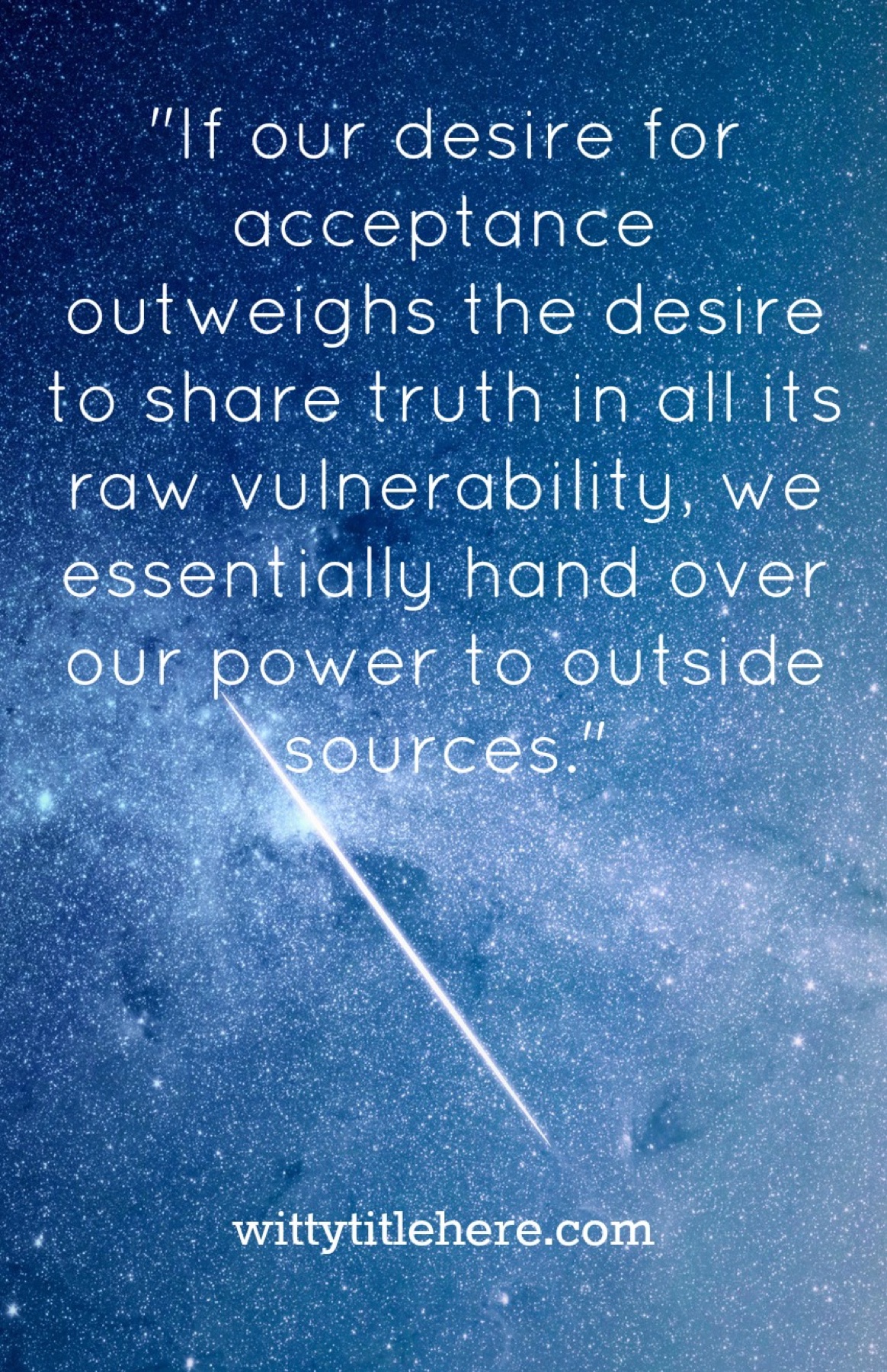
But there’s a fine line we all must walk when it comes to our motivations. As writers, artists and creatives, if our desire for acceptance outweighs the desire to share truth in all its raw vulnerability, we essentially hand over our power to outside sources. Our work ends up being shaped not by our authentic voices, experiences and beliefs, but by what we think people want to hear. And if we don’t get the approval we seek, it’s a dark, lonely feeling.

When we create art with the intention of being popular, the end result only reinforces ideas people already agree with. At best, you’re just adding to the noise. (If you haven’t noticed, there’s a lot of lame-ass content on the internet. Who needs more?) At worst, people will see right through you. Either way, no one really benefits from it.

No good comes from writing watered-down versions of our truth, but it’s especially tragic if our fears and self-doubt prevent us from writing anything at all. If your story is deeply personal, highly controversial or simply way out there, you’re inevitably going to raise some eyebrows. But if you’re trying to avoid pissing people off or making them uncomfortable, you’ve made your job impossible. You can’t worry about the outcome of writing or publishing your story before you’ve even written a first draft.

There are no rules in art or in life. Just the limits we impose upon ourselves.

I turned 26 last week. It’s a weird age—nothing especially special about it. Yet it’s fascinating to me the range of life experiences my peers have had. We live with five roommates, we live with parents, we have kids, we start companies, we buy houses, we travel the world. At 26—or at any age, for that matter—there is no normal.

It can be utterly frustrating when there’s no roadmap for where you “should” be at a certain stage in your life. But it’s also  liberating. It means we can define and redefine our versions of success. And by success, I mean a life of creative fulfillment and happiness, at least a good majority of the time.

So rather than worry about whether we’re going to be judged, ridiculed, laughed at, pointed at, shunned or ignored, let’s make a pact to put integrity before mediocrity. Audacity before fear. We’re never going to please everyone, anyway. Might as well be ourselves.

I don’t give a shit if that sounds hokey. It’s true.

National Novel Writing Month: 7 things you need to prepare

how to prepare for National Novel Writing Month

Well, here it is: I’m participating in this year’s National Novel Writing Month. Let the madness commence.

This is my first time participating in the quest to get 50,000 words of not-entirely-coherent story on the page during the month of November, and it goes without saying that the idea of the whole thing is a little intimidating—and also exhilarating.

In NaNoWriMo, as it’s called, there are generally two kinds of participants: the planner and the pantser. The pantser generally goes in without much more than an idea, some inspiration and a lot of motivation. The planner’s approach varies in intensity, ranging anywhere from a loose outline and some character sketches to a fully fleshed-out, all-but-written story.

Given that quitting halfway through November because I have no idea what I’m doing would be way too easy, I’ve decided to take the planner’s approach by taking notes, creating character backgrounds and generally trying to wrap my head around the story it is that I want to tell. I’m also arming myself with a few essentials to further increase my odds of success.

If you’re participating in this year’s NaNoWriMo—or if you’re on the fence—here are 7 things you need to prepare (whether you’re a planner or pantser):

A fresh notebook

My number-one must-have is a crisp new notebook in which I can jot down notes and ideas away from the computer. I often find that when I’m having a hard time letting the words flow on my laptop, switching to handwritten notes helps ideas come much easier.

I love a high-quality Moleskine, but my notebook doesn’t have to be expensive or fancy—a fresh composition notebook is just as exciting (and way cheaper). Large spiral-bound notebooks are the best for easily turning pages and lying the notebook flat. It’s also a good idea to keep a tiny notebook that you can throw in your bag for when you’re out and about and inspiration strikes.

A file folder or inspiration board

Have a dedicated folder for all the clips, quotes, photos and ideas that inspire your novel. Physical folders or binders are nice for having tactile inspiration to flip through, but digital files can be just as helpful (and easier to reorganize as needed). You can even create multiple Pinterest boards for your setting and characters.

I’ve also found that having a few favorite quotes on writing helps keep me grounded when self-doubt starts creeping in. Looking for some quotes to keep you motivated? I’ve started a NaNoWriMo 2015 Pinterest board of quotes you can borrow from here.

Related: 7 writers on writing & perfectionism

A calendar

November will pass by in a blur, so having a visual reminder of how much progress you’ve made and how much time you have left will be essential for staying on track. Keeping your Google calendar open in another tab will do the job just fine, but if you want the satisfaction of crossing off each day and updating your word count (you need about 1,667 words a day to hit the 50,000-word goal!), opt for a physical calendar you can write on. You can get a free printable NaNoWriMo word count calendar here.

NaNoWriMo prep

Tea and candle optional, but recommended.

A routine

A routine is the probably the most important thing you’ll need and the most difficult to maintain, especially if you’re in school or have a crazy work schedule. Come up with a writing routine before November rolls around so you can simply focus on getting words on the page. If your schedule makes it impossible to hit 1,667 words on certain days, don’t punish yourself or give up. Instead, write what you can on your busiest days—even if it’s just one page—and block longer periods of time during your off-days to make up the difference.

You might need to make some other adjustments to your lifestyle to keep your routine on track. For me, that means getting up and going to bed at the same time every day instead of when I feel like it. And since I work from home on the computer, I’ll need to separate my novel-writing time from my freelancing time so I don’t bounce back and forth mindlessly between the two.

Someone to keep you accountable

Attempting to write a novel in a month is kind of ridiculous when you think about it, and there will definitely be times when you want to bag it or let yourself be distracted by other things. An accountability partner can help you keep your eye on the prize. Whether it’s a friend, a parent or another NaNoWriMo participant, telling at least one other person who you can trust to cheer you on can be the difference between giving up during week one and having a complete first draft on November 30th.

It’s also a good idea to tell your family or roommates about your plan. They might not understand why you’d take on such a masochistic task, but hopefully they’ll support you regardless and know when to leave you alone.

A playlist

This one is mostly for fun, but it can also be incredibly helpful. If you enjoy writing to music, put together a playlist that gets you energized and focused. (Just try to avoid any songs you know all the words to and might be tempted to sing along with!) You can even create a soundtrack inspired by your book’s characters, plot and mood. If your novel takes place in a specific time period, use songs from that decade to put yourself there. Here’s my book’s playlist.

A distraction-free workplace

If you have a designated spot for drafting up your novel, keep the area clutter-free and someplace that you’ll enjoy working. You can stock it with fresh post-it notes or index cards, your favorite healthy snacks, tea, whatever—anything you find comforting or helpful.

If you don’t have a desk and are rotating between your couch and kitchen table,  just remember to take a moment to make your space comfortable and clean, keeping everything you need within arm’s reach. If you get sick of your workspace, head to the nearest public library!

Some other resources you might find helpful:

For writers 17 and younger, NaNoWriMo has a Young Writers Program which includes forums and resources specifically for you. (This might be a great place to find an accountability partner.)

If you want to outline your novel ahead of time but aren’t sure where to start, the Pre-Write Project from Kristen at She’s Novel is a workbook to help you do just that. It’s designed to complete in five days and costs $7. I haven’t used it myself, but I’ve heard good things!

And lastly, a kickass, comprehensive list of prewriting tools to help your novel take shape.


Are you participating in NaNoWriMo, or have you in the past? What are your must-haves?