Anna Barnard Wright: Should we encourage plus-sized beauty?

This is a reader-submitted post. Leave some love for the author in the comments or share it!
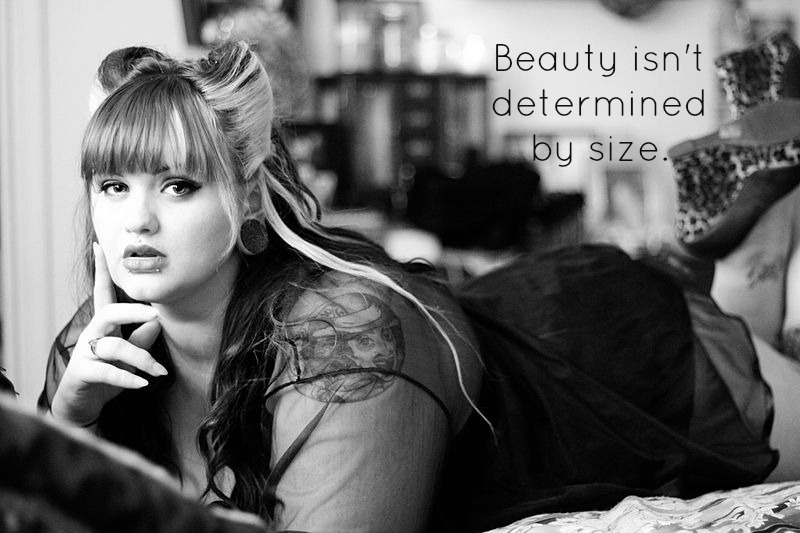
Plus-Sized Beauty

(Hint: Yes.)

For its August issue, Women’s Running magazine featured a plus-sized model on the front cover. There was overwhelming support from the plus-sized community and other decent humans, yet the story sparked outcry from many. I often get into this debate on Twitter (sigh), and it frustrates me that the argument even has to be discussed: Plus-sized models should be equally represented in the media, without backlash.

But first, let’s talk about the ridiculous definition of “plus-sized.” Despite the UK average for a woman being a size 16, models are classed as plus-sized from a size 12 and up. Being a 10/12 myself, I’m often a “large” in Hollister and a very snug “medium” in Urban Outfitters. By this logic, an average, size-16 girl might be an XXL. How can average be based upon XXL? Not only does this make online shopping difficult, but it has a detrimental effect on girls’ confidence and self-esteem. The media would have you believe that an XS is the only appropriate size for young girls, and while it is normal for some, this is simply not a reflection of most of our society. It’s important for retailers to cater to a more realistic range of bodies and lower the bar.

My second issue is those who condemn plus-sized models for being “unhealthy.” (Unsurprisingly, these people also tend to hate feminism, immigrants, human rights, etc.) There isn’t one definitive image of “healthy,” so it isn’t accurate or fair to judge someone’s health purely by his or her physical appearance. The range of healthy BMI’s is actually pretty wide, and people carry weight differently depending on a number of factors.

You also have to consider that metabolism varies from person to person. It’s quite possible that a smaller person eats more than a larger person, but you wouldn’t know it either way. A truly healthy diet involves balance and variety. Foods containing naturally occurring good fats are far more beneficial to your health than many “diet” products loaded with chemicals. Crash dieting does more damage than maintaining a slightly higher yet stable weight.

It baffles me that so many people are willing to cast aside plus-sized models as unhealthy but accept slimmer models, who are overrepresented (their body types make up just 5 percent of the general population), without second thought. A huge problem affecting many of these size double-zero models is drug addiction and using drugs as a means of radical dieting. Yet the Obese Police don’t consider this to be an unhealthy lifestyle. Who sets the standards? I usually hear the argument, “Fat people are a strain on the government, wasting tax-payers’ money.” Politicians waste much more money—target your abuse at them instead.

Of course being overweight isn’t ideal for many, and there’s no question obesity is a serious problem, but not one we should shame people for. In fact, a study by experts at University College London has shown fat-shaming actually has the opposite effect. Over a four-year period, those subjected to “weight discrimination” gained an average of 0.95kg (or two pounds) compared to the control group who lost an average of 0.71kg (around 1.6 pounds). As well as weight gain, fat-shaming leads to self-esteem issues, depression, anxiety, anorexia, bulimia and countless other serious illnesses. These sufferers also need support from the government. A healthy mental attitude and wellbeing have a more positive impact on life. Encouragement beats shame.

Two brilliant role models are YouTubers Louise Pentland (SprinkleofGlitter) and Sarah Rae Vargas (RavingsByRae). They know they’re larger ladies; you don’t need to tell them. However, they focus on promoting self-love, acceptance and embracing what you have. This is especially important for an audience of young girls. They wear what they like and do what they want. They’re happy. Surely this is a healthier lifestyle than constantly feeling ashamed and embarrassed, feeling you’re worth less than anyone else?

No one has the right to punish people for their appearance. Someone else’s weight has nothing to do with you, and it’s not your problem to solve. Weight doesn’t define a person. Plus-sized ladies (and men) have as much right to chase their dreams and feel beautiful as anyone else. It’s not about encouraging obesity—no one sets out with that goal. It’s about encouraging happiness and a healthy mind.
Anna Barnard WrightAnna Barnard Wright is a British sociology student at the University of Durham. She’s an aspiring journalist who writes passive aggressively about beauty, lifestyle and other first world musings on her blog, Collections of Imperfections. Anna is a tea drinking introvert and proudly uncool, though not in the way that’s now considered cool. You can follow her on Twitter and Instagram.


Witty Title Here publishes works from emerging, female-identifying writers. Want to submit your short work of fiction, journalism, humor or opinion writing? Send drafts or pitches to .
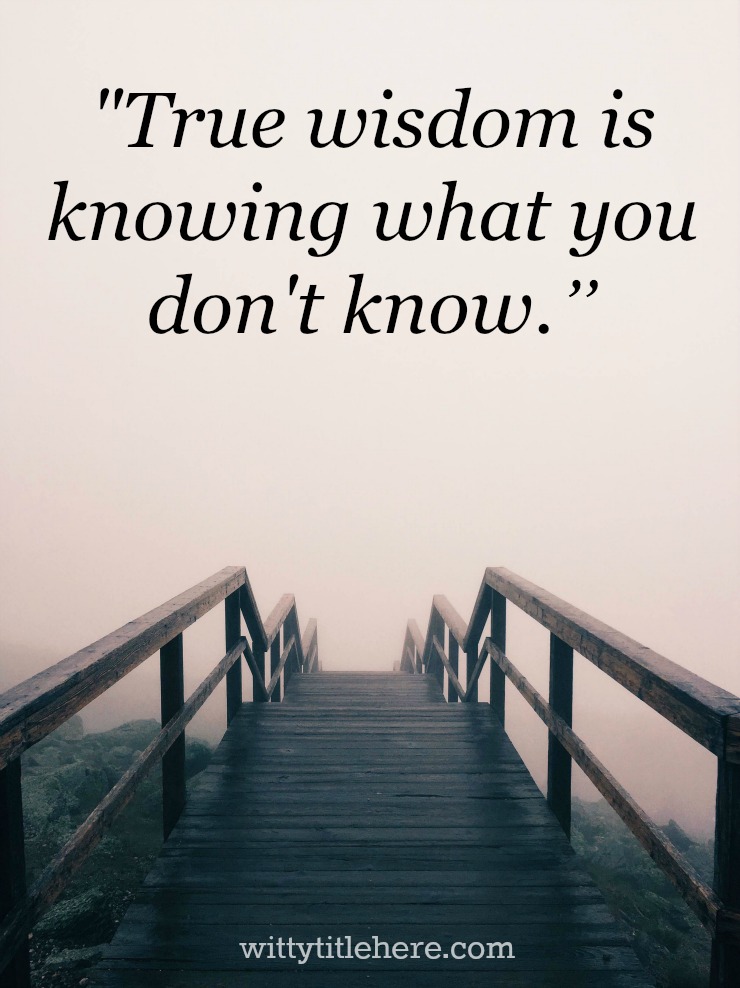
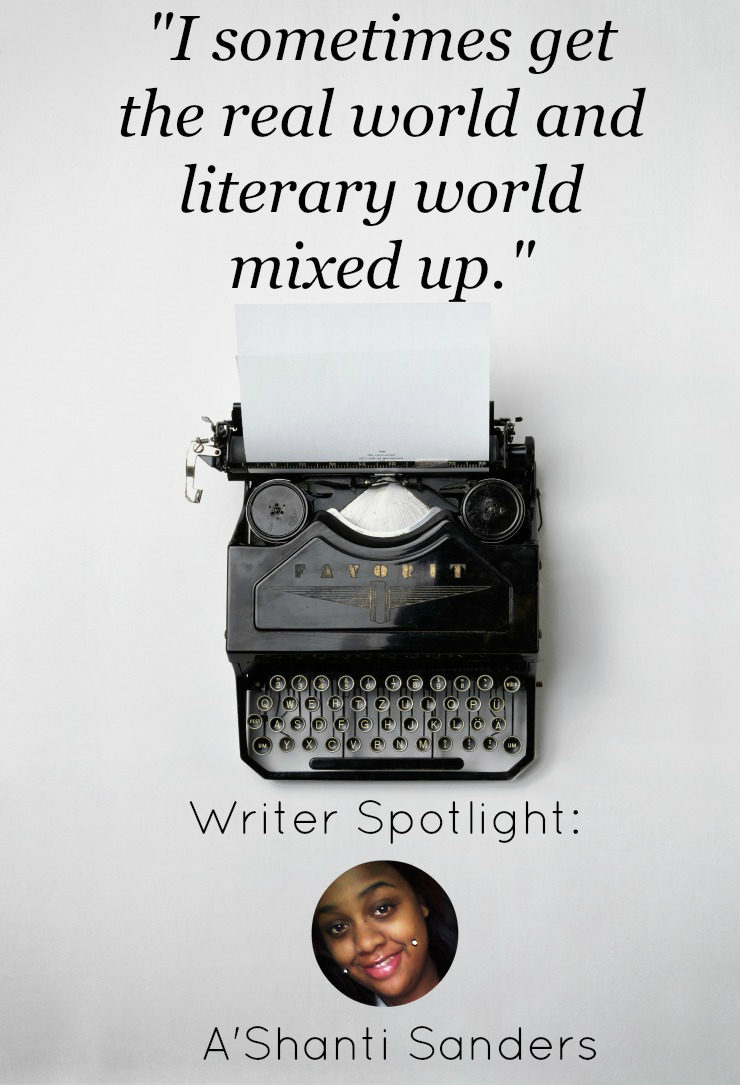
Photo via Wikimedia CC/Tiffany Bailey

Should you really “write what you know”?


"Write what you know" is bad advice. Here's what to write instead.

“Write what you know” can be such frustrating advice.

While not totally useless for a writer simply searching for ideas, it’s also unnecessarily limiting. To a young writer especially, “write what you know” can make you think, “Well, I’m only [insert your age here] and haven’t even experienced [arbitrary measure of life’s progress]. How much do I really know?”

On the flip side, being told to “write what you know” often leads one to forget all the truly fascinating, unique-to-them things she or he does know and skip right to the mundane or useless knowledge they have. “But I’m only an expert on extreme procrastination, Instagram filters, the benefits of rescuing vs. adopting and making the perfect grilled cheese,” you might think. “Who wants to read about that?”

What makes this advice most counterintuitive of all is that if you suggested to a journalist that she only writes what she knows, she’d think you were crazy. Journalists write about all kinds of things they know nothing about. Researching completely foreign topics and writing about them with authority is part of the job. Why shouldn’t other writers do the same?

My counter-advice? Write what you don’t know.

You’ll learn a whole lot more, and your writing will be better for it.

In her essay “The Value of Not Understanding Everything,” Grace Paley explains why, as writers, we should go outside our comfort zones:

“As for an inventing writer, I would say something like this: Now, what are some of the things you don’t understand at all?

One of the reasons writers are so much more interested in life than others who just go on living all the time is that what the writer doesn’t understand the first thing about is just what he acts like such a specialist about – and that is life. And the reason he writes is to explain it all to himself, and the less he understands to begin with, the more he probably writes.”

Admittedly, by itself, the advice to write what you don’t know can be just as vague and unhelpful as its counterpart. But fear not! I’ve got a few suggestions to get your creative juices flowing. Ask yourself these questions when you’re stuck in a writing rut:

What angers you? What confuses or scares you?

What have you always wished you knew how to do?

Who do you admire most? How do they spend their days?

What was daily life for your parents like growing up? Your grandparents?

Did you read or hear something recently that left you with more questions than answers? Seek out the answers to those questions.

What would your polar opposite be like? Write a story about them or interview somebody like them. Make them sympathetic.

These are merely jumping-off points, but I find them to be far more helpful and interesting than generic topics or ideas. It’s more exciting to think about all the things you don’t know but could and can if you simply dedicate the time to learning about them.

As Confucius said, “True wisdom is knowing what you don’t know.”


Writer Spotlight: A’Shanti Sanders

Writer Spotlight: A'Shanti Sanders

Since relaunching Witty Title Here, I’ve been blown away not just by the talent of so many young writers (because duh they’re brilliant), but by how they’re building their platforms and marketing themselves and even self-publishing. That’s exactly what 17-year-old A’Shanti Sanders, the first interviewee of the Writer Spotlight series, is doing.

Already, A’Shanti has self-published five books and shows no sign of stopping. She’s hard-working, smart and so sweet, and every writer could learn something from her disciplined and optimistic mindset.

Meet A’Shanti Sanders

Tell us about yourself!

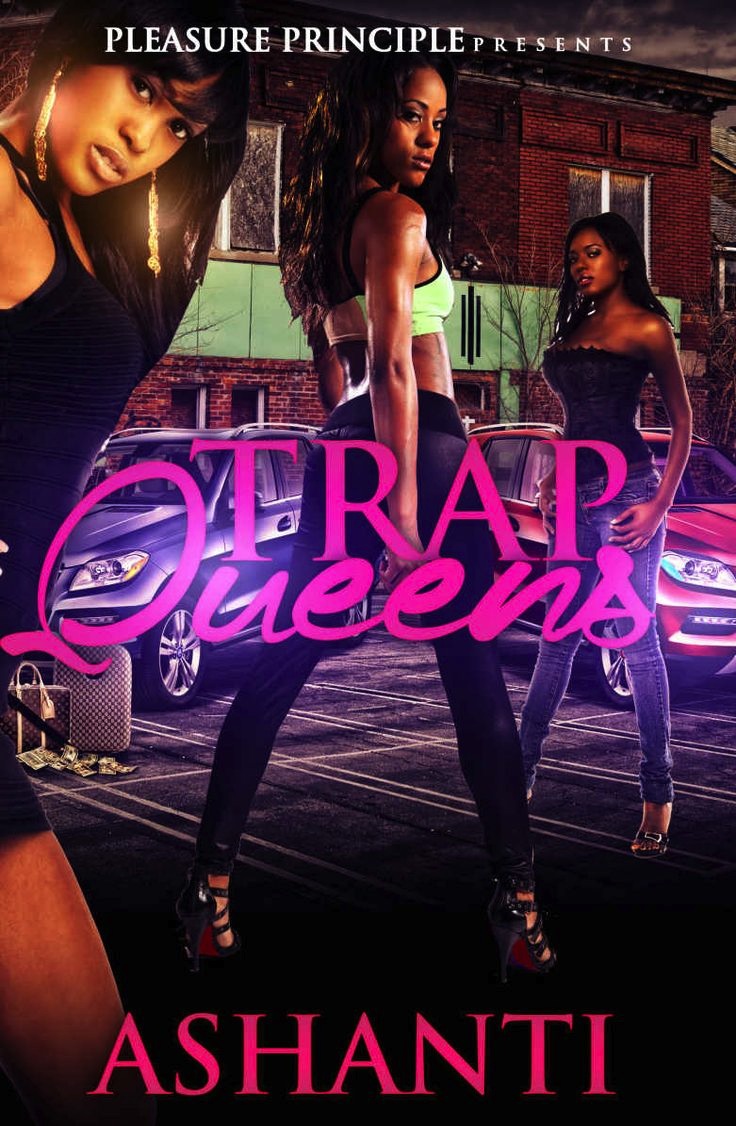
Hello, my name is A’Shanti Sanders, I’m 17 years old, and I write urban street lit books. I have been writing for seven years! I sometimes get the real world and literary world mixed up. I literally write every chance I get, and I mean everywhere. School, the dinner table, in the car—I hear it’s my addiction. I now have five books published on Amazon and Kindle: The Love Homicide series, Trap Queens, and Not Looking for Love.

When and how did you become interested in self-publishing? What made you decide to pursue that route?

I first self-published my books on a great website called Wattpad. I wanted to get my stories out and see how people felt about them. It was really a great place to start.

Describe your writing process. Do you have any routines or habits?

My writing process is simple: Find a seat and get to channeling your feelings, haha. I don’t really have a routine, I can practically write anywhere. With eight siblings you become good at tuning out the world.

What’s the hardest part about writing? The best part?

The hardest part about writing has to be the “writer’s block.” Sometimes you have so many ideas, but you can’t express them how you want. It makes you want to pull your hair out. The best part is getting to be whatever you want when you write. You get to write in the mindset of so many different types of people. It’s amazing.

Tell us about the main characters in your books. Where do you come up with the inspiration for them, and what do you admire about them?

My main characters are always strong and brave individuals who have such a strong voice and great message to teach with their lives. Just like myself. I believe my characters come from the people around me—I come from a very unique background, and it has caused me to meet and imagine very unique people. I admire the strength behind each one of my characters. None of them come from easy lifestyles. They all encounter some very difficult life-or-death situations, but they all handle them in different ways and take them head-on.

Trap Queens by A'Shanti Sanders

What have you learned from self-publishing that might be helpful for others?

I’ve learned that not everyone is going to like your stories, and that it’s a process. You have to take it slow and do a lot of research on the market and what you’re trying to do.

Do you plan to pursue writing as a career? What would you like to be doing in 10 years?

I do plan on a writing career. After two years of self-publishing, I was approached by a great company who signed me, and it has been amazing. In 10 years I see myself as a best-selling author stocked on the shelves of major book stores and doing a lot of great things with my gift of writing. Just like some of my favorite authors.

Who are some of your favorite authors? What are you reading now?

Some of my favorite authors are Talehia McCants, the author of the Paradise and Nightmare series and Joy King, author of the Bitch series. I absolutely adore and look up to those women. Their books are amazing.

Are you working on any projects right now? Can you tell us about them?

Right now I’m working on my Trap Queens series and a few other surprise books for my fans. All I can say is you’re going to go on a roller coaster ride with these dramatic and insane characters. They’ll teach you what life in the ghetto as an American kingpin or queenpin is like.

Any advice for young writers about self-publishing (or writing in general)?

To everyone wanting to self-publish or publish a book period, you can do it! Take your time and research the business. There is a lot to learn. Not everyone is going to like what you write, and you won’t become a best-selling author overnight. Just keep on writing and pushing forward. If you work, I promise you it will be rewarded!


Thanks so much for sharing, A’Shanti! Follow A’Shanti on Twitter and check out her books on Amazon.

#BannedBooksWeek: How to write a book that gets banned

Banned Books Week: How to write a book that gets banned

Warning: This post contains material that may be offensive to people who hate books.

That’s because Banned Books Week is September 27-October 3, which means it’s time to celebrate all the nefarious, diabolical and dangerous literature that has threatened to poison minds everywhere since the dawn of the printing press.

It may seem silly now to think that classics like The Catcher in the Rye and To Kill a Mockingbird were banned from many schools, libraries and even bookstores, but times have changed. People don’t ban books for being blasphemous, suggestive or “too radical” anymore, right?

Wrong. Did you know that the Harry Potter series was banned in many schools for promoting “anti-family” values and black magic? Or that the Captain Underpants series for children was also banned, presumably because it has the word “underpants” in the title? Or that the freaking dictionary has been banned from several schools for including the definitions of dirty words like “genitalia”?

It’s all so ridiculous that it makes me aspire to write a book that gets banned. You, too? Great.

Here are 4 foolproof tips for writing a book that gets banned or, if you’re lucky, burned:

1. Write a book for children or teens.

While plenty of books for adults have been banned, your odds of successfully having your book banned will drastically increase if you write for the overly scrutinized genres of children’s or young adult books. Young, impressionable minds! Purity! Innocence! All qualities that are threatened any time a kid cracks open a book.

2. Make your protagonist have feelings and opinions that question authority or the status quo.

Bonus points for a female character with opinions. Your silencers will hate that. Think The AwakeningLittle Women (especially Jo’s character) or even Hunger Games—all books that have been banned or censored.

3. Include—or even just reference—sex.

Sex scenes, internal dialogue hinting at sexual feelings, masturbation or even a good, old-fashioned Spin-the-Bottle scene should do the trick. Because in the eyes of your critics, sex is inherently bad. And unnatural. Young people don’t know what sex is, and we should prevent them from knowing about it until they’re at least 40. Or never.

4. For that matter, throw in a few of the following:

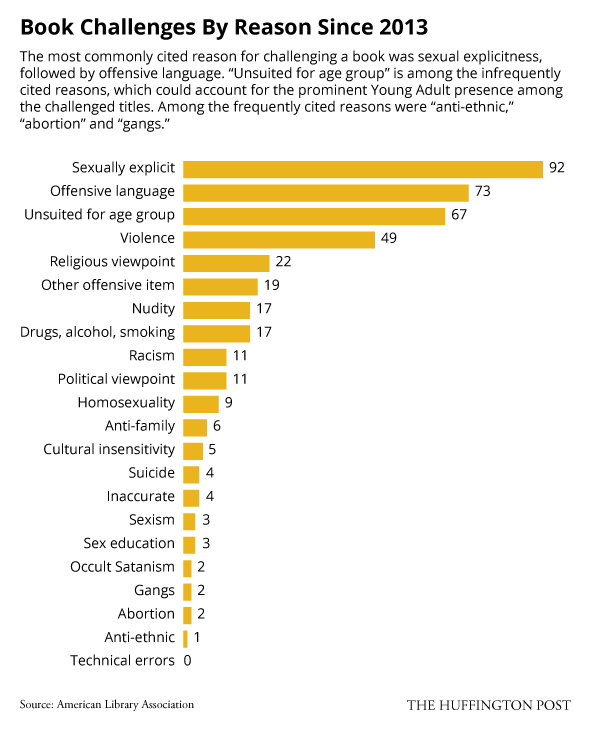
Strong language, violence, drugs, alcohol, homosexuality, witchcraft, political views of any kind, satire, etc. You know, all things one might reasonably expect to encounter or learn about at some point in their lives. Here’s a handy chart you can easily reference when trying to come up with the most ban-able book possible.


Banned Books Infographic

Cool? Now get out there and plot your next communist propaganda masterpiece. Write a book using the guide above, and everyone book censors are trying to “protect” from your book will want to read it. As for me, I’m working on a manuscript about a rebellious girl who takes psychedelics and talks to animals. Although now that I think about it, that sounds a lot like Alice’s Adventures in Wonderland

What would your banned book be about? And what’s your favorite banned book?

Seven writers on writing & perfectionism

7 Writers on Writing

I don’t believe in writer’s block.

do, however, believe perfectionism, fear, inferiority, frustration, distraction and/or existentialism can and often do contribute to a writer not writing. But none of these feelings—nor a resulting lack of productivity—are unique to writers. Why give power to the made-up concept of writer’s block?

As writers, when we’re faced with these feelings of inadequacy, we have two options: give up or power through. The latter always feels better.

These seven writers know all too well what it’s like to be plagued by self-doubt, but they also made it to the other side, and with great success. If you’re dealing with some of these feelings, take comfort in these words of geniuses—then get back to work.


“Perfectionism is the voice of the oppressor, the enemy of the people. It will keep you cramped and insane your whole life, and it is the main obstacle between you and a shitty first draft. I think perfectionism is based on the obsessive belief that if you run carefully enough, hitting each stepping-stone just right, you won’t have to die. The truth is that you will die anyway and that a lot of people who aren’t even looking at their feet are going to do a whole lot better than you, and have a lot more fun while they’re doing it.”

– Anne Lamott, Bird by Bird

“There is neither a proportional relationship, nor an inverse one, between a writer’s estimation of a work in progress and its actual quality. The feeling that the work is magnificent, and the feeling that it is abominable, are both mosquitoes to be repelled, ignored, or killed, but not indulged.”

– Annie Dillard, The Writing Life

“It’s easy to write. You just shouldn’t have standards that inhibit you from writing.”

“Stopping a piece of work just because it’s hard, either emotionally or imaginatively, is a bad idea. Sometimes you have to go on when you don’t feel like it, and sometimes you’re doing good work when it feels like all you’re managing is to shovel shit from a sitting position.”

– Stephen King, On Writing

“One must be pitiless about this matter of ‘mood.’ In a sense, the writing will create the mood. If art is, as I believe it to be, a genuinely transcendental function—a means by which we rise out of limited, parochial states of mind—then it should not matter very much what states of mind or emotion we are in. Generally I’ve found this to be true: I have forced myself to begin writing when I’ve been utterly exhausted, when I’ve felt my soul as thin as a playing card, when nothing has seemed worth enduring for another five minutes . . . and somehow the activity of writing changes everything.”

– Joyce Carol Oates, Paris Review interview

“I believe that the so-called ‘writer’s block’ is a product of some kind of disproportion between your standards and your performance… One should lower his standards until there is no felt threshold to go over in writing. It’s easy to write. You just shouldn’t have standards that inhibit you from writing.”

– William Stafford, Writing the Australian Crawl

“The feeling that the work is magnificent, and the feeling that it is abominable, are both mosquitoes to be repelled, ignored, or killed, but not indulged.”


“You need a certain head on your shoulders to edit a novel, and it’s not the head of a writer in the thick of it, nor the head of a professional editor who’s read it in twelve different versions. It’s the head of a smart stranger who picks it off a bookshelf and begins to read. You need to get the head of that smart stranger somehow. You need to forget you ever wrote that book.”

– Zadie Smith, Changing My Mind: Occasional Essays

“The difference between writers and critics is that in order to function in their trade, writers must live in the world, and critics, to survive in the world, must live in literature. That’s why writers in their own work need have nothing to do with criticism, no matter on what level.”

– Grace Paley, Just As I Thought


What are your favorite writing quotes? What gets you out of a slump?


@wittytitlehere on Twitter

Witty Title Here: a manifesto

Witty Title Here: a manifesto

Welcome to the new Witty Title Here. If you’re a writer, this space is for you. If you’re a young female writer, this space is for you especially.

Here’s what I believe:

I believe that every young woman has a voice. 

Each of those voices deserves an outlet and platform. Being heard and acknowledged is crucial to having the confidence to continue honing your craft into adulthood. (I know from experience.) Community is a powerful thing for a writer, and the more diverse that community, the better.

I believe in supporting one another through our struggles and successes.

I believe we can smash the sexist myth that girls are toxic to one another by lifting each other up (and shouting it from the rooftops and/or the internet). I believe everyone needs mentors and that at some point, everyone should become someone else’s mentor. Don’t feel like you’re ready to be a mentor? Be someone else’s cheerleader, then. It’s good for your soul and theirs.

I believe in writing every day—even when it’s hard.

Especially when it’s hard. Even if it sucks. The only way to get better at writing is to keep writing… and then write some more. Then maybe go for a walk. Read a book. Then get back to writing.

Other things I believe:

If you write, you are a writer. Not an “aspiring” writer. (Though I understand the urge to use that qualifier.)

A feminist is someone—male, female or otherwise—who thinks women, and those who identify as women, should have equal rights and privileges as men. Simple and complex as that. Really.

Women have the power to give themselves permission to do what makes them happy—like write.

Young adult fiction is valuable, underrated, overly criticized and necessary.

The term “women’s fiction” should be banned. Have you ever seen a “men’s fiction” section in a bookstore?

What is Witty Title Here?

Witty Title Here is a community is for all women who write, but especially young women who are new to writing and/or have few outlets for their work. For a long time, WTH was my personal blog. Those archives still exist, if you’re interested in some lifestyle writing. I’m proud of those years of work.

A bit about me

My name is Cassie, I’m 25 years old, and I’ve written articles, essays, emails, blog posts, grocery lists, diary entries, short stories, bad poetry, song lyrics and this here manifesto, among other things. Two years ago, I moved across the country from Baltimore to Los Angeles for grad school (in journalism!), and now I’m a freelance writer living in the Bay Area. I’m also a feminist, foodie and aspiring dog owner, and I think we should be friends.


Now it’s your turn